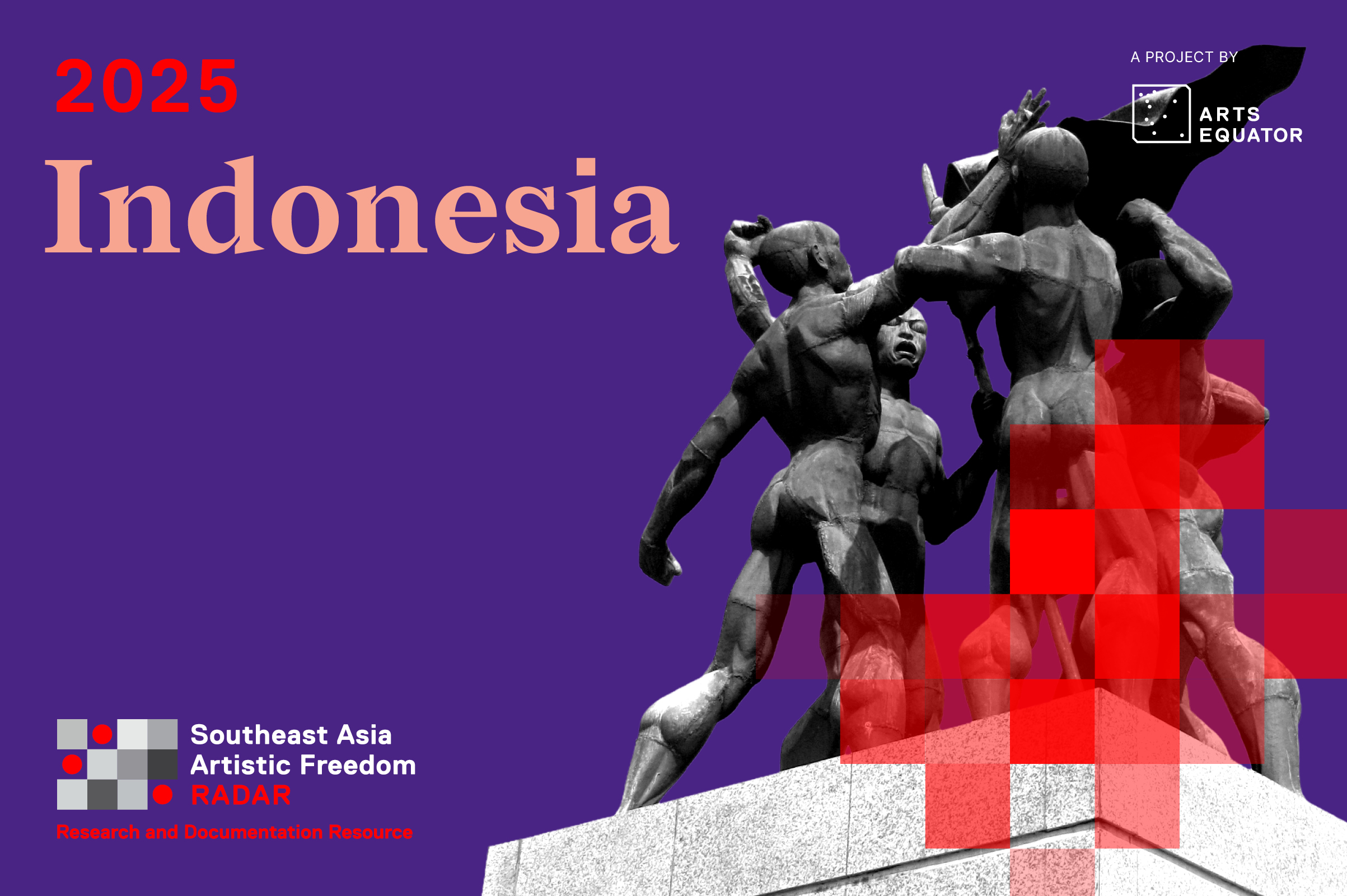
The key findings and analysis of artistic freedom in Indonesia from the Southeast Asia Artistic Freedom RADAR, 2025.
Introduction
2025 marked the return of strongman dictatorship to Indonesia. Elected in November 2024, President Prabowo Subianto—only the third directly elected president in the nation’s history—bears close ties to the late General Suharto, the mastermind behind the genocidal New Order regime from 1964 to 1998. Personally, Prabowo was once married to Suharto’s daughter. Politically, he served in the final years of Suharto’s rule as the Army’s Special Forces commander when 23 activists were kidnapped during the May 1998 demonstrations, 13 of whom remain missing.[1] Accusations of Prabowo’s involvement were repeatedly raised by observers during his first bid for the presidency in 2014, casting the military man’s possible election, at the time, as a threat to hard-fought democracy.[2]
Fast forward to now, when Prabowo has finally ascended to power, such warnings manifest as a painful reminder of the past. In the first full year of Prabowo’s presidency, freedom of expression—often the indicator of good governance—is increasingly under attack. According to the Independent Journalists Alliance (Aliansi Jurnalis Independen), there were 89 cases of violence against journalists in Indonesia throughout 2025, an increase compared to the 73 cases in 2024.[3] Rising threats were cited as a key reason behind the Indonesia’s Press Council (Dewan Pers) giving a score of 69.44 for the nation’s 2025 Press Freedom Index. While good enough for the “fairly free” category, the score is way below the “free” status, which has a score range of 81-100 points. The 2025 score is also notably lower than what was achieved during the previous presidential period, which consistently scored above 71 from 2019 to 2023.[4]Freedom House rates Indonesia as “Partly Free” in its Freedom in the World 2025 report, scoring 56 out of 100.
Impact on artistic freedom
Artistic freedom displays a similar oppressive targeting through the predominance of state-led censorship in recent years. In 2025, state authorities acted as the chief instigator in 24 of the 30 cases recorded in RADAR, with the remaining 6 cases arising from non-state agents. That translates to 80% of this year’s cases enacted by the state. Enforcement agencies such as the police and military were involved in 10 of those cases, followed by regulatory bodies with 9 cases, and non-arts authorities with 5 cases. Of the 6 non-state cases, 3 were the work of faith-based leaders or religious groups, while civil society groups and arts stakeholders each were responsible for one case each, and the final case was enacted by anonymous agents.
Given the perpetrators, it is no surprise the challenges mostly target works with political content. There were 8 such cases and half of them involve murals featuring a skull with a straw hat. In the popular Japanese anime series One Piece, black flags bearing this symbol are carried by a crew of pirates in their mission to challenge a draconian regime and fight for freedom. People began painting murals with the One Piece symbol in response to President Prabowo Subianto’s call to raise the national flag ahead of Indonesia’s Independence Day on 17 August. This trend had not been received well by the Indonesian state representatives. Sufmi Dasco, the country’s Deputy House Speaker, deemed the flag displays an “attempt to divide the nation”, while Firman Soebagyo, a lawmaker from the Golkar Party, suggested it could be treason.[5] The statements went viral, coinciding with attempts by the authorities to erase and cover up the murals which raised considerable ire amongst citizens.
Through arts censorship, the state works hard to patch its fragile public image. This was apparent in the wake of public protests in late August, in which a police vehicle sped toward a crowd of demonstrators and ran over Affan Kurniawan, a 21 year old motorcycle courier.[6] Affan’s death became a public cause, inspiring artists across cities to criticize the state. On 31 August in Denpasar, a group of artists painted “Affan Dibunuh 1312” (Affan Killed by Cops) on a strip of wall overlooking Jalan Bypass Ida Bagus Mantra, one of the city’s main streets.[7] The next day, in Yogyakarta, another group painted “Awas Intel” on a busy intersection in Jalan Brigjen Katamso.[8] In the Indonesian culture of public protests, the expression “awas intel” commonly serves as a warning for fellow protesters, as the term “intel” refers to plain-clothed police or military officers who do surveillance work for the authorities. Within days, both murals were covered up by paint.
Seen historically, this turn toward political content not only signifies a shift in the practice of arts censorship in Indonesia, but also the societal anxieties of the people. Before the pandemic, the most prominent themes targeted were gender and religion, even during the election years in 2014 and 2019. This year, there were 8 works that touched on gender and sexuality that were targeted in a persistent act of moral policing, tying with the number of cases targeted for political content. Six were films from the Jakarta World Cinema Festival, one was a blanket ban on LGBTQ content on Netflix and the final was discussion on the book Pembangunan untuk Siapa? Kisah Perempuan di Kampung Kami (Development for Whom? The Story of Women in Our Village). Surprisingly, there were only three works targeted for perceived religious deviations, two of which were allegations of blasphemy against popular singer-songwriter Hindia, accused of using ‘satanic’ imagery on stage.
In terms of overall numbers, there are only slight differences. There were 30 cases recorded in 2023, 37 in 2024 and 30 this year. The general patterns also look similar, with state agents responsible for approximately 60 – 80% of the cases between 2023 – 2025.[9] The state-sponsored COVID-19 Task Force was responsible for 75% of the total challenges from 2020 – 2022. At the time, these cases were largely considered to be a ‘necessary evil’. Pandemic emergencies legitimized the state’s maneuvers to expand surveillance on civil life, leading to the increased presence of military and police officers at grassroots level. In hindsight, this helped set the stage for the top-down power dynamics that the new regime has benefited from.[10]
The political power constellation has enabled the state to act with little fear of repercussion, leading to bolder methods when targeting artists or artworks. In February 2025, Sukatani—a punk band that exclusively performs with masks on stage—revealed their faces in a video and issued a public apology to the national police chief. The apology was related to one of Sukatani’s more popular songs, Bayar Bayar Bayar (Pay Pay Pay) released in 2023, that criticizes rogue police officers who abuse their authority.[11] In the video, the band stated that the song would be removed from streaming services. Later, media reports alleged that officers from the Cyber Research Directorate of the Central Java Regional Police had been surveilling and intimidating the band since August 2024. In January 2025, the band was reportedly stopped by police officers on their way home to Purbalingga, Central Java, after a gig in Bali. Sukatani’s decision to apologize on video came after this encounter with the police.[12] The group later claimed that they were intimidated into making the apology. The Central Java Regional Police denied any formal ban or pressure, claiming citizens are free to express opinions (tempo.co, 2 March 2025).
The Sukatani case suggests a concerted attempt by the state to sow a climate of fear—a move straight from the playbook of Suharto’s New Order.[13] Back then, authorities proactively staged public displays of aggression to discourage people from scrutinizing and confronting the state’s mechanism of power. This peaked in the mid-1980s during the ‘petrus killings’, when secret police officers executed alleged criminals and political dissidents, then deliberately left their bodies in public places to terrorize the populace.[14] The apparent aim was to foster a culture of submission, which became the engine that powered Suharto’s New Order. Prabowo’s rule is neither as violent nor bloody yet. But the new regime has more than enough enabling pretexts for the old ways to reemerge—the latest being the need for “authoritarian methods to combat corruption,” a point that the President Prabowo raised during a keynote speech in Indonesia Economic Outlook, February 2026.[15]
This proactive nature of Indonesia’s arts censorship is also reflected by the high number of pre-emptive strikes against artistic practices. There are 15 such cases in 2025, and 12 of them are instigated by state agents. Most of them are concentrated in the film industry and this raises a genuine concern. In September, Lembaga Sensor Film (LSF/Film Censorship Board) denied screening permits for 8 foreign films in Jakarta World Cinema, an international film festival organized by a private company. While the censorship board had done similar things in the past, those targets were usually large-scale theatrical releases that attracted public pressure due to sensitive topics, such as Noah in 2014 for religious depiction and Lightyear in 2020 for queer representation. LSF tends to be more lenient in the film festival space given the small audience numbers. In a previous case, the Jogja-NETPAC Asian Film Festival 2021, LFS did not give public screening permits for two queer themed short films, Monica Vanesa Tedja’s Dear to Me and Paul Agusta’s Pages. In response, the festival held an invitation-only screening, exclusive for people who had already purchased the tickets for both films. The LSF did not challenge the organizer’s decision.
There was no similar reprieve in the Jakarta World Cinema case. The 8 titles challenged by the LSF are almost exclusively distributed within film festival circuits, yet these films were now being subjected to a similar level of scrutiny as theatrical releases with higher potential audiences. Seven titles, including Marcelo Caetano’s Baby and Pedro Pinho’s I Only Rest in the Storm, were targeted for nudity and/or queer relationships, while Nadav Lapid’s Yes was prohibited as part of a wider boycott of works linked to Israel in response to the genocide in Gaza. There has never been a precedent like this in locally organized film festivals.
While it is tempting to dismiss these cases as an isolated incident, one needs to consider the potential long-term impact of such systemic disciplining in an arts sector. Between 2023 and 2024, there were 23 cases of raids and detainment of organ tunggal bands in South Sumatra, which could be traced to a circular issued by the regional police chief banning remix and electronic music, claiming that both genres tended to encourage criminal conduct such as drug use and violence. At the time, South Sumatra was renowned as the province with the second-highest rate of narcotics abuse in Indonesia. The circular legitimized a two-year systemic hunt for any gathering or public event that involved such music, be it a regular concert, a wedding, or even a circumcision ceremony. In 2025, only two such cases were recorded in the region. The sharp decrease possibly points to the ‘success’ of the South Sumatran authorities in disciplining that particular sector. In other words, art and cultural practice becomes a collateral target in the war on drugs. One could imagine the costly loss of jobs, income, and social ties incurred in the process.
Conclusion
Today, it might only be one film festival or community event. Tomorrow, a similar process of self-censorship may expand to a whole genre. The Sukatani case shows that authorities will harass with impunity. After a year under President Prabowo, bad habits from Indonesia’s despotic past are back and likely to remain. To prevent further erosion of artistic freedom and democracy, civil society, artists, and the press must unite to demand strong protections and accountability.
On this count, RADAR recorded encouraging signs of resistance. Police intimidation may have forced Sukatani to pull “Bayar Bayar Bayar” from streaming platforms, but the song found a second life in the streets. Students and activists turned it into a rallying cry, chanting it through February’s protests against President Prabowo’s budget cuts and policies.[16] On a smaller scale, artists have also shown they can hold their ground. In the “Awas Intel” mural case, the painters refused to be silenced when threatened by police. “I cited some laws, insisted that our actions are protected by law. And they became very quiet,” recalled Kinky20, one of the targeted artists.[17] These scattered acts of defiance are sparks, but for hope to take root, they must multiply. Resistance cannot remain isolated; it must grow louder, stronger, and engage different stakeholders in collective action.
Footnotes
[1] “27 Tahun Reformasi: Tim Mawar Pion Penculikan Aktivis 1998,” tempo.co, 20 May 2025. Accessed on 15 February 2026.
[2] “Fresh doubt cast on Prabowo’s suitability to rule,” thejakartapost.com, 9 June 2014. Accessed on 15 February 2026.
[3] “Catatan Tahun 2025: Pers dalam Pusaran Otoritarian,” aji.or.id, 14 January 2026. Accessed on 15 February 2026.
[4] Andreas Yoga Prasetyo, “Testing the Essence of Press Freedom,” kompas.com, 9 February 2026. Accessed on 15 February 2026.
[5] Kelly Ng, “How a cartoon skull became a symbol of defiance in Indonesia,” bbc.com, 7 August 2025. Accessed on 16 February 2026.
[6] Yudono Yanuar, “Chronology of Ojol Driver Killed by Tactical Vehicle and Subsequent Protest at Brimob Headquarters,” tempo.co, 29 August 2025. Accessed on 17 February 2026.
[7] @smots__, Instagram, accessed on 5 November 2025.
[8] “Nekatnya Seniman Jogja Bikin Mural ‘Awas Intel’ di Depan Aparat,” detik.com, 7 September 2025. Accessed on 17 February 2026.
[9] Adrian Jonathan Pasaribu, “Indonesia: Artistic Freedom Report 2023-2024,” radar.artsequator.com, 9 May 2025. Accessed on 13 February 2026.
[10] Sana Jaffrey and Eve Warburton, “Prabowo’s Indonesia: Inheriting Democracy at Dusk,” carenegieendowment.org, 22 October 2024. Accessed on 18 February 2026.
[11] “Punk band Sukatani removes viral song from streaming services,” thejakartapost.com, 21 February 2025. Accessed on 13 February 2026.
[12] Rizki Dewi Ayu, “Duduk Perkara Grup Band Sukatani Minta Maaf ke Kapolri,” tempo.co, 20 February 2025. Accessed on 15 February 2026.
[13] Wijaya Herlambang, Cultural Violence: Its Practice and Challenge in Indonesia, VDM Verlag Dr. Müller, 2011, 24-29.
[14] “’Petrus’ gross rights violation,” thejakartapost.com, 25 July 2012. Accessed on 12 February 2026.
[15] Firda Cynthia Anggrainy, “Kelakar Prabowo: Jangan-jangan Perlu Sedikit Otoriter untuk Lawan Koruptor,” detik.com, 13 February 2026. Accessed on 16 February 2026.
[16] Hanin Marwah, “Aksi Indonesia Gelap: Massa Nyanyikan Lagu Sukatani hingga Poster Wanted Prabowo,” tempo.co, 22 February 2025. Accessed on 17 February 2026.
[17] “Fakta-fakta Mural ‘Awas Intel’ di Jokteng Wetan Jogja Berujung Didatangi Polisi,” detik.com, 4 September 2025. Accessed on 17 February 2026.
Adrian Jonathan Pasaribu
Adrian Jonathan Pasaribu is the chief editor and co-founder of Cinema Poetica—a collective of film critics, activists, and researchers in Indonesia. In 2013, Adrian participated in Berlinale Talent Campus as a film critic, and since then regularly organized or mentored film criticism workshops in Indonesia. He has also curated several film festivals, including Festival Film Dokumenter, Jogja-NETPAC Asian Film Festival, and Singapore International Film Festival. In 2020, as part of Cinema Poetica, Adrian contributed several writings for Antarkota Antarlayar: Potret Komunitas Film di Indonesia (Between Cities and Screens: Film Communities in Indonesia), a book published by Jakarta Arts Council.
- Adrian Jonathan Pasaribu
- Adrian Jonathan Pasaribu
- Adrian Jonathan Pasaribu
- Adrian Jonathan Pasaribu
Similar Reads