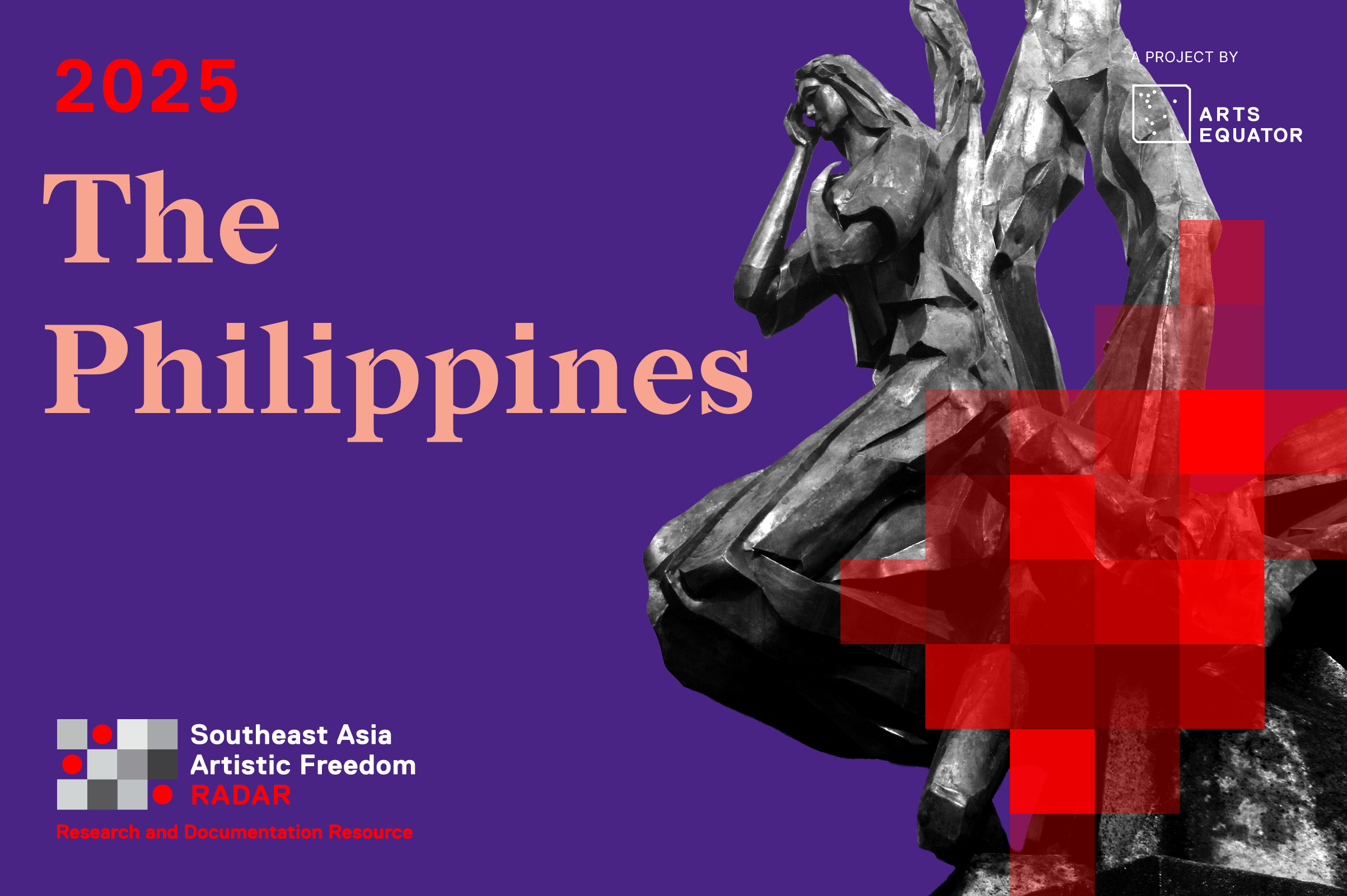
The key findings and analysis of artistic freedom in The Philippines from the Southeast Asia Artistic Freedom RADAR, 2025.
Introduction
The Philippines has been in a constant state of crisis throughout 2025. From natural disasters to sustained political instability, the past year was no stranger to headlines that literally shook the country to its core.
At the beginning of the year, incumbent President Ferdinand “Bongbong” Marcos Jr. and Vice President Sara Duterte (and daughter of previous president, Rodrigo Duterte), were already exchanging barbs in public, making apparent the tensions between the two highest positions in office.
In March, former president Rodrigo Duterte was arrested by the International Criminal Court (ICC), accused of crimes against humanity and extrajudicial killings, linked to his “war on drugs,” a major campaign during his administration. While Marcos Jr. has previously shielded Rodrigo Duterte from the investigation, in January 2025, the new government said it would “respond favourably” to an ICC arrest (Rappler, 24 Jan 2025). This clearly demonstrated the rift between two influential political families: the Dutertes and the Marcoses (Democratic Erosion Consortium, 15 May 2025).
Geopolitically, China’s claim for the West Philippine Sea became more aggressive. It has been well documented that the Philippines has faced water cannon attacks, constant shadowing and collisions in the areas in which China stakes a claim to (Indo-Pacific Defense Forum, 1 Dec 2025). This has led the Philippines to make stronger alliances with the USA, a seeming priority of the current administration.
At the same time, the Philippines experienced numerous typhoons, particularly disastrous in the south of the country. Hundreds were injured and died, dozens went missing, and properties were damaged in the aftermath of Typhoon Kalmaegi (Tino) and Super Typhoon Fung-wong (Uwan). This experience then exposed anomalous flood control “ghost” projects that had used up trillions of taxpayers’ money for projects that were never concretised. In an attempt to quell public anger, the Marcos Jr. administration formed the Independent Commission for Infrastructure (ICI) to investigate the misuse of public funds, but it failed to make substantive headway. This led to the Trillion Peso March and Baha sa Luneta (Flood in Luneta) protests by mid- to the end of the year (The Benildean, 23 Sept 2025).
Beyond everyday politics, the lack of checks and balances, and tendency to allow personal conflicts between two warring families to dictate governance revealed the structural weakness of the Philippines in 2025. Overall, the Philippines is ranked as “Partly Free” by Freedom House, maintaining the ranking of 58/100 in freedom of civil and political rights, same as in 2024. Its press freedom rankings has, according to Reporters Sans Frontiere, improved to 116/180 from 2024 when it was ranked 134 out of 180 countries.
Artistic freedom in 2025
RADAR logged eight cases in the Philippines in 2025, keeping the number of cases per year fairly consistent over the past four years. The cases include two films, Dreamboi and Food Delivery: Fresh From The West Philippine Sea; one mural by art students in the south of Metro Manila; six cultural activists, the Imus 5 and Julie DM Bega; and two visual artists. While the numbers are relatively low, the methods used have been more violent or harsh.
This year, it became more apparent that the protection artists need in terms of their freedom of expression leans towards safeguarding their overall welfare. A number of cases exemplify the risks artists and cultural workers face particularly through police assault, censorship, and the false labelling of persons as terrorists and as anti-communist threats (locally known as “red-tagging”).
One of the gravest cases is that of the murder of Gold Dagal, a comedian who was assassinated before a performance. Other cases involve detentions and allegations of psychological abuse of artists taking part in protests. Gold Dagal is the first case of an artist assassination during the Marcos Jr. regime[1] as far as we can ascertain. There was speculation that he was targeted due to his viral monologue on the Independent Christian Church, Iglesia ni Cristo (INC), where he talked about the group’s wealth and implied provocative actions by the church’s minister (Rolling Stone Philippines, 18 March 2025). After his death, the hashtag #JusticeForGoldDagal trended over social media, with stand-up comedians, comedy groups and non-profit organizations showing support.
Gold Dagal’s murder sits within the larger context of violence and extrajudicial killings in recent years. While there is no indication that Gold Dagal’s assination is linked to the state, it does replicate the institutionalized inhumanity that has permeated society. According to reports from Amnesty International, Duterte’s administration (2016-2022) had been plagued by accusations of extrajudicial killings allegedly carried out by the government in pursuit of its so-called war on drugs. The Marcos Jr. administration has been accused of inaction, through his silence on issues, and his decision not to undo the rulings and task forces created by the previous regime (National Union of Journalists Philippines, 2023).
Although generally more subtle in 2025, assault and detention for activism has been a long-standing practice in the Philippines. Historically, artist-activists are prone to attacks, such as in the case of writer Amanda Echanis, who was arrested during a raid on December 2022 under the charge of counterinsurgency and released early in 2026, and community theater practitioner Alvin Fortaliza, who was wrongly charged as an accomplice to two counts of murder in 2019 and released in late 2025.
There remains a palpable culture of violence especially when artists make works or express opinions that are critical of the government and institutions. Freedom of expression of artists and cultural activists in the country has been curtailed by call outs, verbal accusations, charges, arrests and even death, as seen in the documented cases this year.
Cultural activists, the Imus 5, were detained and threatened with guns while in the midst of creating protest art against demolitions and land-use conversions in the province of Cavite, south of Manila. In another case, graffiti artist DECAY allegedly experienced psychological torture while detained. Photographer RAVE sustained physical injuries for being present during the 21 September 2025 anti-corruption protest[2].
Another method which has recurred in RADAR’s documentation of cases over the past 5 years, is red-tagging. According to GlobalWitness.org, red tagging is “a practice that connects online and real-world harms, where individuals or groups are labelled as communists, terrorists or subversives with inadequate evidence.” It has been used as a blanket reasoning for the arrest, intimidation and harassment of those who express their dissent, especially during the time of Duterte. In 2024, the Supreme Court of the Philippines declared red-tagging a threat to the right to life, liberty and security[3].
Still, at the end of 2025, theater practitioner and rights advocate Julie DM Bega became a victim of red-tagging as posters featuring her image as an example of mass organization leaders appeared around Legazpi City, Bicol, southeast of Metro Manila, during the run of her play Higit sa Pag-ibig: The Musical (Beyond Love: The Musical). The musical ran as planned, with her organization, Sining Banwa, and other organizations declaring support to the artist.
Agents responsible this year for challenges to artistic freedom include allegations against a corporate sponsor, when Food Delivery: Fresh From The West Philippine Sea was dropped from the line of a festival it sponsored (The Straits Times, 16 July 2025), to a private educational institution’s removal of a student’s mural (Today’s Carolinian Facebook, 7 January 2025), to the anonymous shooter of Gold Dagal. In 4 of the 8 cases, the police or military were involved, pointing to the serious challenges to artistic freedom faced by artists and cultural workers.
In RADAR’s 15 years of documented cases in the Philippines, 52% of the film or broadcast related cases were attributed to the Movie and Television Review and Classification Board (MTRCB), which was responsible for oversight over film and TV and home videos. In September 2020, the MTRCB announced its intention to expand its power to regulate content on video-on-demand platforms such as Netflix, iFlix, and Amazon Prime Video, claiming all unrated content violated existing laws (Rappler, 5 September 2020).
This year, MRTCB was only present in one case, when it gave Dreamboi an X rating, before relenting with a rating of R18 (Rolling Stone Philippines, 30 October 2025). Nonetheless, this was the year that the scope of MTRCB’s power was indeed expanded when Senate Bill 2805 was passed to cover digital and streaming content. Cultural groups stated that this diminishes freedom of expression and creativity. The Concerned Artists of the Philippines (CAP) posted on their 2025 Proposed Artists’ and Cultural Workers’ Agenda that “censorship by regulatory bodies such as MTRCB curtails artistic freedom and intimidates cultural workers. The MTRCB and similar agencies must be held to public accountability standards to prevent partisan influence, political pressure, or any attempts to restrict the right to free expression” (Bulatlat, 9 June 2025). At the same time, The Philippine Independent Producers Guild said, “We express deep concern that vague and expansive censorship criteria, especially those related to national reputation and political stability, could be weaponized against filmmakers tackling socially relevant or critical themes. This poses a direct threat to freedom of expression, cultural discourse, and the democratic value of dissent” (Global Voices: Advox, 17 June 2025).
Although there is no apparent thread that visibly connects all found cases in 2025, it remains evident that censorship is still rampant in the country. Red tagging, illegal arrests, artwork removals, and movie banning are not new, with the youth of the nation as its primary victims.
Religion, gender and geopolitics are themes that are constantly censored, signalling the discomfort and ignorance of those in power. For example, Dreamboi was initially censored by MTRCB for being too sexually explicit in portraying the transgender experience. After film organizations and directors expressed support for the film online, it was approved for release and given the R-18 rating, restricting the age of the viewers. Food Delivery: Fresh From The West Philippine Sea was allegedly dropped from a festival and almost did not have its premiere in the country, as it touched on topics of humanity amidst the territorial issues between China and the Philippines on the West Philippine Sea. The organizers, whose business has strong ties with China, mentioned “external factors” as the reason for the cancellation of the movie’s launch (The Straits Times, 16 July 2025). Such themes are subject to continuous censorship because they lay bare current socio-political conditions.
Conclusion
The election hopes of Marcos Jr. as being more progressive compared to the hard line of the Duterte years has proven illusionary. As the country has faced turmoil, artists and cultural workers and cultural activists have continued to stand with the people, putting their bodies and their art to speak out against corruption, promote inclusivity and challenge narrow ideas of morality, despite challenges from a range of agents.
It should be noted though that there was constant support from the arts and culture community–whether individuals in their respective fields or cultural organizations that enabled these cases to move along. Noteworthy cases include Dreamboi and Food Delivery: Fresh From The West Philippine Sea proceeding with their premieres despite initial contestation from the government and private groups.
2025 also saw some small victories of ongoing cases from previous years. These include the film Alipato at Muog (Ember and Fortress), which in 2024 received an X rating (effectively banning it from screenings in public cinemas). It was targeted for featuring the story of the disappearance of activist Jonas Burgos, the brother of the director. In 2025, the film won several national film awards, including Best Picture, Best Documentary and Best Editing in the 48th Gawad Urian Awards, regarded as the highest award for a film given by critics in the Philippines. Another high-profile case from 2023 is that of drag artist Pura Luka Vega, who was acquitted of violations of doing indecent or immoral plays.
The public, on the other hand, are cognizant of the cases but continue to consume art within their comfort zones.
This research surfaced cases that can be described as a microcosm of wider international issues. While the Philippines faces larger and seemingly more pressing political matters, censorship is still prevalent. Therefore, constant monitoring is necessary to keep tabs on cases that may slip through the cracks.
References and footnotes
[1] In 2022, poet, musician and activist, Ericson Acosta was reportedly killed, allegedly in an encounter with the military in Negros Occidental. International rights organisations have called for an investigation into his killing.
[2] An artist or cultural worker targeted exclusively for their role as activists and without a link to arts/cultural activity is not included in our monitoring, as RADAR’s inclusion criteria is focused on challenges to artistic freedom.
[3] SC: Red-Tagging Threatens Right to Life, Liberty, and Security, Supreme Court of the Philippines, 8 May 2024
“2025: The Year the Philippines Was Tested on All Fronts”, Malaya: Business Insight, 20 December 2025.
“The Philippines in 2025: A year of challenges, change and crisis”, Sunstar, 30 December 2025.
“Philippines to ‘respond favorably’ if ICC seeks Interpol arrest warrants over drugs crackdown”, Rappler, 24 Jan 2025.
“Rodrigo Duterte’s Trial Before the International Criminal Court: Unprecedented”, Fulcrum, 12 March 2025
“Growing Rifts, Breaking Ties: Marcos v. Duterte as an Institutional Crisis in the Philippines”, Democratic Erosion Consortium, 15 May 2025.
“Philippines to focus on South China Sea code of conduct despite China’s obstinance”, Indo-Pacific Defense Forum, 1 December 2025.
“Trillion Peso March: Marching against a flood of lies and stolen funds”, The Benildean, 23 September 2025.
“Philippines: Country Profile”, Freedom House.
“Asia Pacific: Philippines”, Reporters Without Borders.
“How the Murder of Comedian Gold Dagal is a Blow to Free Speech”, Rolling Stone Philippines, 18 March 2025.
“Slow justice, impunity reigns in the country: Statement of the Philippine Coalition for the International Criminal Court (PCICC) on World Justice Day”, Amnesty International, 17 July 2024.
“JOINT STATEMENT | Threats to Truth-telling, Free Expression Worsen During Marcos Jr.’s First Year in Office”, National Union of Journalists of the Philippines, 2023.
“What is red-tagging, and how does it harm climate action?”, Global Witness, 15 July 2025.
“SC: Red-Tagging Threatens Right to Life, Liberty, and Security”, Supreme Court of the Philippines, 8 May 2024.
“Court clears student activist after five years in detention”, Inquirer.net,15 January 2026.
“Political detainee Alvin ‘Chai’ Fortaliza freed after nearly seven years in jail”, Bohol Island News, 19 December 2025.
“Beijing accused of trying to block screenings of Filipino documentary on South China Sea”, The Straits Times, 16 July 2025.
“WATCH: Murals painted around the SAFAD building were painted over and washed away despite reports of no prior warning given to students and faculty”, Today’s Carolinian Facebook, 7 January 2025.
“Directors’ Guild opposes bill expanding MTRCB powers to regulate streaming platforms”, Rappler, 5 June 2025.
“‘Dreamboi’ Director Rodina Singh on the Realities of Being a Trans Woman in Film”, Rolling Stone Philippines, 30 October 2025.
“Press Release: Senate approves bill to strengthen MTRCB mandate”, Senate of the Philippines: 20th Congress, 2 June 2025.
“MTRCB wants to regulate content on Netflix, other video-on-demand platforms”, Rappler, 5 September 2020.
“Artist orgs oppose bill expanding MTRCB powers”, Bulatlat, 9 June 2025.
“Filipino artists reject Senate bill expanding powers of film and TV regulating body”, Global Voices: Advox, 17 June 2025.
Iris Ferrer
Iris Ferrer is an independent cultural practitioner from Manila, Philippines.
- This author does not have any more posts.
Similar Reads