Overview
A return to more authoritarian leadership, recent armed conflicts and geopolitical realignments have negatively impacted civil and political spaces in Southeast Asia. According to the Civicus Monitor, Myanmar and Vietnam are rated Closed, Cambodia, Thailand, and the Philippines, Repressed, while Malaysia and Indonesia are designated as Obstructed in 2025.[1]
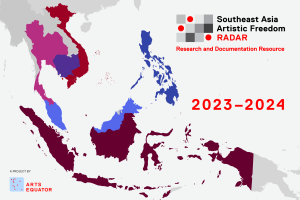
Against this backdrop, repercussions on artistic freedom are inevitable. In 2025, RADAR documented 159 challenges to artistic freedom in 7 countries in Southeast Asia: Cambodia, Indonesia, Malaysia, Myanmar, The Philippines, Thailand and Vietnam.[2]
Malaysia again led with 44 cases, followed by Myanmar’s 37 cases. Vietnam’s cases almost doubled at 22 incidents, compared to the 12 in 2024. The forms most frequently targeted were films and broadcast media (43), books and publications (41) and music (27), all of which tend to have wider public reach. Notably, the number of visual arts cases nearly doubled, at 23 compared to last year’s 12. This was in part due to the targeting of murals and graffiti art at anti-government demonstrations in Indonesia.
The country reports by our research team, Manin Ath (Cambodia), Adrian Jonathan Pasaribu (Indonesia), Zikri Rahman (Malaysia), Sar Phyu (Myanmar), Iris Ferrer (Philippines), Phoothong ‘Aor’ Patporn (Thailand) and Linh Le (Vietnam) examine the key cases and provide detailed analysis of the state of artistic freedom in their countries.
Key Observations
Escalation of methods used
The methods used to violate artistic freedom have escalated, with murder, attacks, arrests, intimidation, surveillance and destruction of works amongst the methods documented[3]. In countries where a culture of violence exists, be it civil war, armed conflicts or, in the case of the Philippines, the so-called war on drugs, the risks of physical harm were greater.
Goldenier Dagal,[4] a Filipino comedian known for his biting criticism of an evangelical church, was assassinated in March 2025. The killers remain at large. Artist-activists in the Philippines using their art at public demonstrations also faced arrests and abuse. In Myanmar, the impact of the ongoing civil war has led to deaths, imprisonment and abuses of artists and cultural workers as first reported by Free Muse in 2021. This year, the pressure on artists continued. In October, five artists were arrested[5] for criticizing a pro-junta film on social media. Damage to artworks were also recorded, the most egregious being the damage to heritage sites and ancient temples[6] due to the Cambodia-Thai border conflict which broke out in May 2025.
Moral Panic
In 56% of the cases, works or creators were accused of transgressing imposed boundaries of morality, traditional values, customs, gender, sexuality or faith and were subjected to moral policing by state and non-state agents.
Moral panic has reduced the tolerance level such that even self-help books aimed at steering teens through adolescence, such as The (Nearly) Teenage Girl’s Guide to (Almost) Everything[7], were banned in Malaysia.
In Vietnam, several Viet Pride[8] events were cancelled for the first time in the event’s 13-year history, a worrying shift in a country known for being progressive on LGBTQ issues. Policing of women’s bodies and their place in public life continue to activate religious authorities, state bodies and members of the public in the region, particularly in Malaysia, where local K-pop girl group, Dolla[9], and indie musician killamisha were both targeted.
Controlling the narrative
Artists in the region who used their art to highlight rights abuses, corruption, socio-economic issues, environmental damage and other crises, were vulnerable to pressure, with 28% of the cases logged under politically motivated targeting.
Thirteen Burmese artists in exile[10], who remain active critics of the junta, had their citizenship revoked in June. In Thailand, the Independent Political Satire Group of Thammasat University[11] accused the police of surveillance and intimidation. Five cultural activists, known as the IMUS 5[12], were arrested for their protest art against demolitions and land-use conversions in Imus City, Philippines. Teater Payung Hitam’s play Wawancara dengan Mulyono (Interview with Mulyono)[13] was cancelled when the group was locked out of the theatre by the venue operator. Mulyono is believed to be the birth name of the former President of Indonesia, Joko Widodo.
Geopolitical considerations
There is a rising threat to artistic freedom linked to armed conflicts and geopolitical considerations. There were 12 cases attributed to transnational factors, such as the Cambodia-Thailand conflict, China’s territorial claims in SEA and the Gaza genocide.
In a case of transnational censorship that made international headlines, Constellation of Complicity: Visualising the Global Machinery of Authoritarian Solidarity[14] at the Bangkok Arts and Culture Centre was censored under pressure from Chinese officials. The removal of Fresh Delivery: Fresh from The West Philippine Sea[15] about Filipino fishermen in waters contested by China from a Manila film festival, and damage to a Falun Gong[16] display in Malaysia were also attributed to Chinese interference.
The Thailand and Cambodia conflict has destabilised the region and displaced millions in an area rich in tangible and intangible heritage. In January 2026, Cambodia submitted a damage assessment report, detailing extensive damage within the Preah Vihear complex, a UNESCO World Heritage site, and the 14th century Ta Krabei temple.[17]
Active revisionism
On the topic of heritage, the multidirectional pressure on artistic freedom is shrinking the spaces for long-embedded artforms, traditional practices, and historical narratives in the region.
Proponents of Kuda Kepang[18], a Javanese folk performance long present in maritime Southeast Asia, have been accused of blasphemy in Malaysia and Indonesia.
A performative nationalism blind to the interconnected histories and shared culture in the region is taking root. Academic talks on Khmer history in Thailand and the pre-Islamic Bujang Valley[19] civilization in Malaysia faced stiff opposition from individuals and organizations unhappy with research that did not align with their populist concepts of religious or ethnic purity.
Tag teams
The state was responsible for initiating the first step in 73% of the cases documented, but non-state agents wielded significant power to instigate, or escalate attacks on artists and artworks.
A worrying trend is the spontaneous tag-teaming between state and non-state agents. In Vietnam, the government issued an advisory, Dispatch 69[20] against a number of songs and musicians for being ‘cultural deviations’.[21] Although the dispatch did not call for any bans of artists, or censoring of works, it motivated some netizens to suggest the musicians be banned outright. In Thailand, complaints by a local fisheries association that a Netflix production, EVL[22] would damage the reputation of the country’s fishing industry, led several state agencies to review the production plans.
Practice makes perfect
RADAR’s tracking of non-state interventions over the past 15 years reveals that non-state agents have used their performance of outrage or concern to accrue power and legitimacy to control artistic and cultural expression in the region. The frequency and efficacy of such actions have normalised the role of non-state actors as censors, despite them not having any legal power.
In Malaysia, some filmmakers now consult religious authorities before filming to avoid post-production controversies that may cause financial losses[23]. A concert by Indonesian singer-songwriter Hindia[24] was cancelled after religious groups accused him of blasphemy. Significantly, the festival organiser confirmed that it was not that the police had not issued a permit, but that the event organizer “had not received approval from several community leaders”.[25]
Legislature and regulations
While RADAR does not formally document news laws and regulations, in monitoring challenges to artistic freedom, we note that in recent years, there is a rise in new laws or a strengthening of regulations that may negatively impact artistic freedom in countries such as Vietnam[26], Malaysia[27], Philippines[28], to name only a few. In Myanmar, the use of ‘law fare’ as detailed in the country report, is used to devastating effect. Above and beyond the established regulatory and enforcement framework, authorities also employ arbitrary, sometimes extra-judicial methods.
Solidarity and resistance
Based on 15 years of data collected by RADAR, resistance is more likely when the artist knows their rights, has access to a strong support network, receives public support and has some measure of financial security.
Anecdotally, this is more likely in countries where there is a more developed civil society and rights ecosystem, such as Thailand, Malaysia, Indonesia and The Philippines[29].
In 2025, there were several examples of resistance, pushback, or recovery.
Indonesian punk band Sukatani accused the police of intimidating and coercing them to apologise for and remove their song about police corruption, Bayar, Bayar, Bayar[30] (Pay Pay Pay) from streaming platforms. The group earned public support and their song subsequently became an anthem for a series of public protests against President Prabowo’s budget cuts and policies.
Dreamboi[31], a Filipino film about trans identity, was twice denied a public screening permit, before it was given an R18 rating on appeal, following support from artists and film students.
In 2021, former Thai National Artist in Literature, Suchart Sawatsi,[32] sued the government when it revoked his national artist honour for his outspoken views on politics and the monarchy. Although his case was dismissed in 2025, the legal challenge was a principled and brave one.
Malaysian publisher Gerakbudaya’s Hall of Banned Books is a bold initiative to make visible the volume of publications proscribed by the government on a regular basis.
Finally, in 2025, drag artist Pura Luka Vega[33], who faced intense pressure, arrests and multiple legal charges arising from a drag performance in 2023, was acquitted by the Manila Regional Trial Court of the violations of doing indecent or immoral plays.
Conclusion
The increase in cases and the severity of methods used indicate that those acting against artistic freedom have become more emboldened. Artists and cultural workers face threats from governments, religious figures, members of the public, arts peers/stakeholders, corporations and even foreign governments.
There is a general climate of fear across the region. Global instabilities have exacerbated the threats to artistic freedom, and those in power are seizing the moment to control the powerful voices of the artist at the time when it is most needed.
Footnotes
[2] Previous years’ data covered 6 countries; in 2025, RADAR began documenting cases in Myanmar. Radar does not yet cover Laos, Brunei, Singapore, East Timor.
[3] To read case summaries, go to Radar Database.
[4] Malasig, Jeline,“‘Real legend’: Tributes, calls for justice pour in for stand-up comedian Gold Dagal after his death”, Philstar, 18 March 2025.
[5] ‘Election under fear’: Junta persecutes critics of its poll, Frontier Myanmar, 11 Dec 2025.
[6] Sharma, Shweta, “Iconic cultural sites under threat as half a million flee Thailand-Cambodia border clashes”, The Independent UK, 11 Dec 2025.
[7] Kementerian Dalam Negeri, “Senarai perintah Larangan”, EPQ.KDN
[8] Lien Hoang, “Vietnam scraps LGBT events after years of expanding rights,” Nikkei Asia, 26 September 2025.
[9]“Malaysian girl group Dolla’s ‘immoral’ video pulled over religious backlash”, CNA, 18 Nov 2025.
[10] Jackson, Will, “Myanmar junta revoking citizenship of actors, singers and other celebrities”, ABC News, 23 September 2025.
[11] State officials’ surveillance of Thammasat University students ahead of the traditional football match Thai Lawyers for Human Rights, 24 March 2025
[12] Tugalon, Aizel, “Rights group demands immediate release of ‘Imus 5’” in Bulatlat,1 July 2025.
[13] “Kronologi Penggembokan Pentas Kelompok Teater Payung Hitam Berjudul Wawancara dengan Mulyono,” Tempo, 18 February 2025.
[14] McPherson, Poppy, and Napat Wesshasartar, “Thai gallery removes China-focused artworks after ‘pressure’ from Beijing.” Reuters, 8 August 2025.
[15]Cepeda, Mara, “Beijing accused of trying to block screenings of Filipino documentary on South China Sea.” The Straits Times,16 July 2025.
[16] “Falun Gong exhibits allegedly seized by ‘China police’ near National Monument”, Free Malaysia Today, 23 August 2025
[17] “Cambodia reveals damage to UNESCO-listed temple after Thailand clashes”, in France 24, 6 Feb 2026.
[18] Three to face Batu Pahat Syariah Court over viral ‘djinn ritual’ Kuda Kepang clip, Malay Mail, 30 Aug 2025
[19] Group demands USM halt Bujang Valley talk over ‘Hindu-Buddhist agenda’, Free Malaysia Today, May 2025
[20] Official Dispatch No. 69-CV/BTGDVTU
[21] Tuyết Anh, “B Ray – GDucky và loạt nghệ sĩ “xóa sổ” MV sau đề nghị chấn chỉnh các sản phẩm âm nhạc “lệch chuẩn văn hóa””, Kenh14, 29 October 2025.
[22] “Fisheries Association objects to Netflix series filming in Thailand.” Prachachat Business News, 30 August 2025.
[23] Zikri Rahman, “Of Participatory Censorship in Malaysia”, ArtsEquator, 4 Sept 2023.
[24] “Hindia Lomba Sihir dan Feast Resmi Batal Tampil di Kota Tasikmalaya,” CNN Indonesia,16 June 2025.
[25] “Polisi soal Baskara Hindia Gagal Manggung di Tasik, Ada Penolakan,” cnnindonesia.com, 15 June 2025.
[26] Critics decry Vietnam’s ‘draconian’ new internet law, The Guardian, 24 Dec 2024
[27] Hajar Umira Md. Zaki, Fahmi says organisers agree to ‘kill switch’ for Coldplay concert tonight, amid protest by Perikatan, Malay Mail, 22 Nov 2023
[28] Alabaso, Kevin, “Senate OKs bill allowing MTRCB to regulate online streaming platforms”, ABS-CBS News, 2 June 2025
[29] In 2026, RADAR will begin a new research project to document the ecosystem of support for artistic freedom in Southeast Asia.
[30] “Sukatani Akhirnya Buka Suara Soal Intimidasi sampai Tawaran Jadi Duta Polri,” Tempo, 2 March 2025.
[31] Lirio, Albert Josef, “’Dreamboi’ gets green light from MTRCB after getting X-rated twice.” ABS-CBN News. 21 October 2025
[32] “Court dismisses case of Suchart Sawatsi—the National Culture Commission’s revocation of the National Artist title was lawful.” Thai Lawyers for Human Rights, 22 Sept. 2025.
[33] Reyes, Juna. “Drag artist Pura Luka Vega acquitted by Manila court.” Rappler, 10 June 2025.
Kathy Rowland is the Co-Founder of and Head of Research at ArtsEquator. She has worked in the arts for over 30 years, in the areas of critical writing and arts advocacy, with a special interest in artistic freedom of expression. Through ArtsEquator, Kathy has promoted critical discourse in Southeast Asia, designing programs such as the Asian Arts Media Roundtable and Critics Live! and the ArtsEquator Writing Fellowship. She has written and presented on arts censorship and artistic freedom in Southeast Asia since the early 2000s. In 2022, she launched the Southeast Asian Artistic Freedom RADAR (Research and Documentation Resource) which researches and documents challenges to artistic freedom in Southeast Asia. In Feb 2025, Kathy was a guest speaker on the “Artistic Freedom: The Road Ahead” panel, organised by the Permanent Delegations of Norway and Sweden at the UNESCO Headquarters in Paris as part of the 20th anniversary celebration of the UNESCO 2005 Convention on the Diversity of Cultural Expressions.
- This author does not have any more posts.
Similar Reads